A Strange Phenomenon
So I noticed a strange phenomenon. Like everyone else, I had printed a stack of business cards, with my business logo on the front, and contact details on the back.
After some years, I realized that exactly zero people had contacted me based on the information on the card. In fact, I had subconsciously been using the cards as a way to make people go away -- a tool to end conversations that I did not want to be in.
For example, often staff at conferences or events have a quota of companies they have to talk to, given to them by their managers. Their job was to make me fill a questionnaire or pitch a service at me whether I wanted it or not, but their KPI was how many business cards they collected. So we were both happy to skip all the other parts if I just gave them a card. I went through hundreds of cards in this fashion.
Meanwhile, any actual business leads would just take a photo of the card, or immediately send me an email or chat message. They never actually took a card, because we all have smartphones now and it's a bit silly to hand out little pieces of paper as a method of storing contact information.
This got me thinking -- what could I do to make business cads more fun? Perhaps something that elicits at smile, brightens your day, or at the very least is the starting point to a conversation instead of just a way to politely avoid one. Like many hardware engineers, I settled on PCB business cards -- functional electronic circuits in the form factor of a business card.
Design Goals
At least for the first card, the design had to be simple. Few components, plenty of board space for logos and text. Everything should be SMT, and wherever possible, should be only on the verso of the board to leave the recto clear.
It also had to run off a 3V coin cell, CR2032 or smaller. It should also run for as long as possible, so that I wouldn't have to fuss over whether my business card was out of batteries or not.
As it turns out, one of my colleagues wanted a PCB business card too! So I designed theirs first. I put together a few features I wanted to integrate:
- I wanted some blinking lights, integrated into their logo.
- Some of the logo should be silkscreened in, other bits would be metallic (copper + solder paste + solder mask layers)
- It should use the attiny10, because I have a lot of them.
- It should have an interesting talking point to spark conversation.
Implementation
I used the low-power blinking light technique from my other projects, to implement 3 lights that blink in a sequence as part of their logo. With the sleep modes of the microcontroller being used aggressively, and a highly optimized method of using the LED, battery lifetime should be 3-5 years of continual blinking for a normal CR2032 cell.
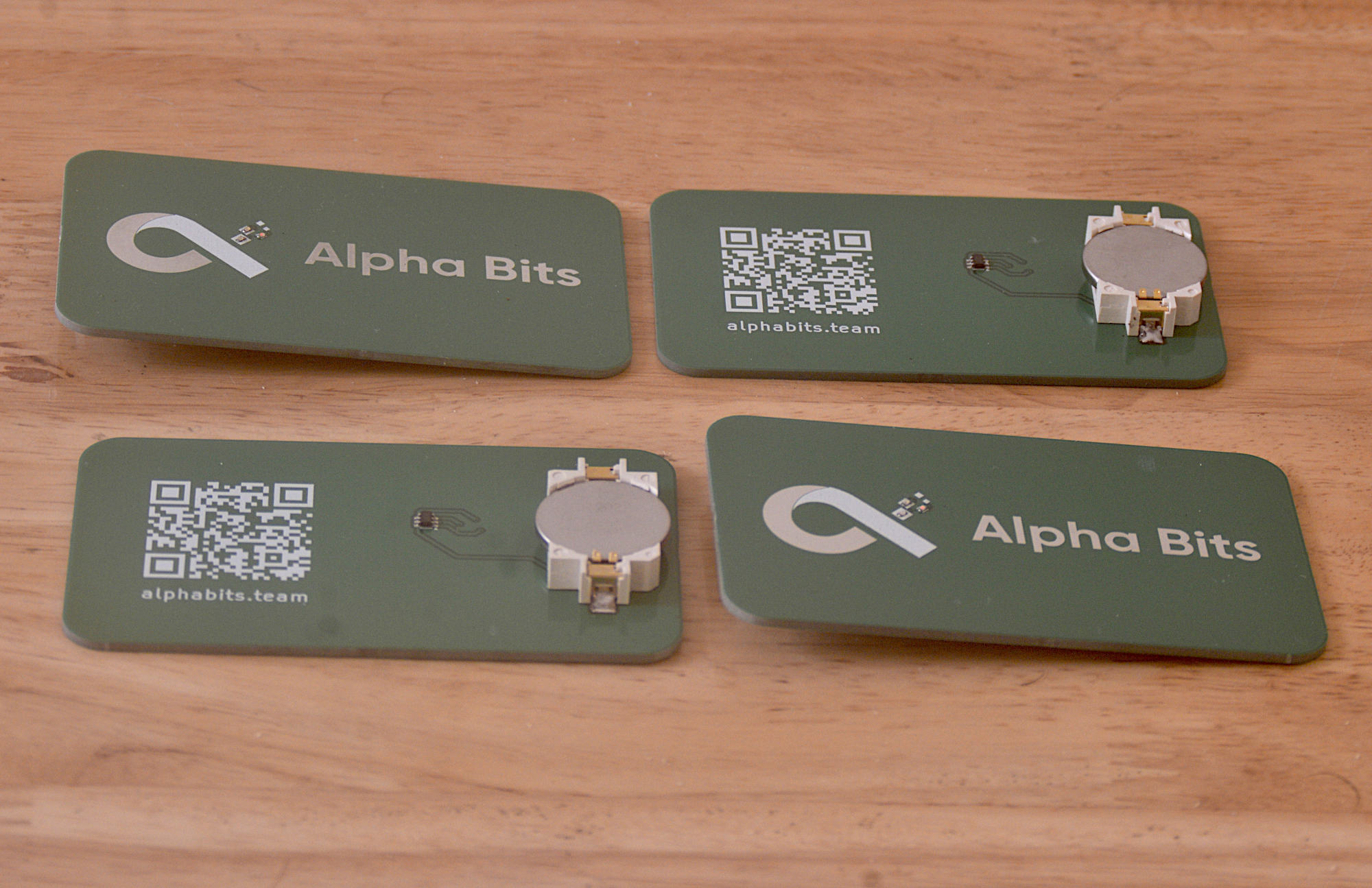
I'm really pleased with how their logo came out too. What was left was a talking point about the card -- I was originally going to suggest the awesome low power consumption. However, while recording a video of the card, I noticed something odd!
The pattern of blinking lights in the video recording was not the same as in reality. It turns out there's an interaction (like a beat frequency) between the way I use the LEDs (precise microsecond pulses) and camera shutter speeds that makes them generally appear to blink out-of-order. I had optimized the behavior of the LEDs to exploit the persistence-of-vision in the human retina to make them appear brighter than they actually were, and use less power. The unintended side effect was a pattern that was only visible in-person!
I thought this was cooler, and reinforces the idea that it was important that two human beings met in-person. Moreover, a pattern that is invisible to machines, created by hand-coding assembly is a great story in this day and age!
The "invisible to machines" part may be a bit of a stretch: a very fast or very slow camera could probably pick it fine. It's "close enough to true" to make a good story though. The intent is to share a sense of wonder, not deceive anyone!
Future Plans
This came out really nicely, I expect I'll be making these for more people in the future! I won't make much money doing it, but I think it will make the world (very slightly) more interesting. Moreover, every time my colleagues go to a meeting, they will be doing business development for me too, since people will ask about their cards.
Of course, I can do much more than flash lights, that was just an easy one to do first. My own business card should play Pong, of course. For one or two players. Still on an attiny10 of course! I've always wanted to write a little game on the attiny10.